FAIR ASST
The CMRR software downloads have migrated to a new site!
If you have not visited this page since Dec 26, 2025, you will need to reset your password. Your username is the email address that you used to sign the University of Minnesota license agreement.
Please be aware that while Siemens C2P agreements are for the specific scanner+institution, the University of Minnesota license agreement to download sequences on this site is for an individual. If your institution needs to change or add additional authorized people to download sequences, each person will need to sign the license agreement and then CMRR will create an account on this site.
FAIR ASST and OPTIMAL FAIR perfusion imaging methods were two variants of the widely used pulsed arterial spin labeling (PASL) method, FAIR (Flow-sensitive Alternating Inversion Recovery), to better facilitate non-contrast enhanced brain perfusion imaging applications. These methods were first developed at UT Southwestern Medical Center and further improved/upgraded at CMRR.
Background
The intrinsic low signal-to-noise ratio (SNR) characteristics of arterial spin labeling (ASL) and reduced SNR in slices acquired later in the sequence due to signal losses from T1 relaxation and label washout make whole-brain high-resolution perfusion imaging challenging. High-resolution perfusion imaging can be better achieved by using only limited number of slices sufficiently covering brain regions of interest, such as the hippocampus or the cerebellum. However, when applying the widely used pulsed arterial spin labeling (PASL) method FAIR (Flow-sensitive Alternating Inversion Recovery) for such studies of regions in the mid-brain or lower brain, the superior labeling of FAIR can introduce confounding effects for cerebral blood flow (CBF) quantification and adverse artifacts (1-2). FAIR with Active Suppression of Superior Tagging (FAIR ASST) is a variant of FAIR that resolves those issues. In FAIR ASST, the superior tagging of FAIR is suppressed by applying saturations at the labeling stage on the superior side of the imaging slab. The implementation of FAIR ASST provided in this package uses the mode 12 for superior tagging suppression (2).
Features
The FAIR ASST sequence contains several important and flexible features, allowing further customizations to satisfy users’ specific needs.
- Imaging slab pre-saturation is supported with two execution modes: a single saturation before ASL inversion RF pulses or three saturations using mode 12 as for ASST (1-2). The latter can provide improved imaging slab pre-saturation and minimize the subtraction errors caused by the imperfect inversion profile (3).
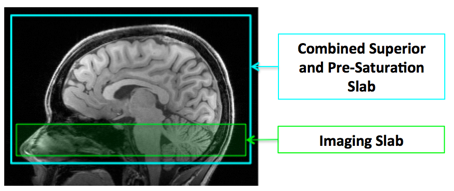
- When both pre-saturation and superior saturation are requested, a single saturation RF pulse will be applied covering both the superior tagging region and imaging slab (Figure 1).
- HSN RF pulse (N>= 4) can be selected for FAIR inversions to reduce RF peak power that is usually limited at ultra high fields, e.g. 7T.
- Both QUIPSS II and Q2TIPS are supported with great flexibility via multiple user interface (UI) parameters: the number, duration, slab size and temporal gaps of saturation RF pulses to define temporal bolus width (please refer Figure 1 in the reference 2).
- Up to two M0 images can be acquired at the end of ASL series acquisition.
- Bi-polar flow-encoding/crushing gradients are available to suppress hyperintense intravascular signals.
Example
License
Obtaining a license
The available supported software versions are listed below. If you are interested in obtaining these sequences, please follow this process to obtain a CMRR license:
- Obtain authorization from your Siemens Regional Collaboration Manager for the specific software you would like to license.
- Contact your Siemens Regional Collaboration Manager for authorization. Please ask them to use the following text in the agreement: "developed by Dr. Xiufeng Li and colleagues (“DEVELOPER”), employees of the University of Minnesota." If you are experiencing any delays working with your Siemens Regional Collaboration Manager please contact Colin Giambrone (colin.giambrone@siemens-healthineers.com).
- Send the completed authorization form to Xiufeng Li
- Select the license from the OTC website and complete the license agreement.
- CMRR will send you your account information.
Please note that the entire licensing process may take up to two weeks to process.
Once you have executed a C2P agreement and have been given an access password, the sequence binaries can be downloaded from the Download link(s) below by selecting the desired release number.
Note: The C2P agreement in step 1 applies to the institution (scanner), whereas the University of Minnesota license agreement in step 2 applies to an individual. If someone else at your institution has historically been the download contact for sequences and you would also like download access, please sign the University of Minnesota license agreement and CMRR will create a download account for you.
Citation
Li X, et al. Improved quantification of brain perfusion using FAIR with active suppression of superior tagging (FAIR ASST). J Magn Reson Imaging. 2011; 34:1037-44. doi: 10.1002/jmri.22734
Li X and Metzger GJ. Feasibility of measuring prostate perfusion with arterial spin labeling. NMR Biomed. 2013; 26:51-7. doi: 10.1002/nbm.2818
Contact
If you have noticed a bug or have a request for a new feature in a future release, please contact Xiufeng Li. Be sure to include the sequence variant and the model of scanner you are using in the problem description.
Download
References
Li X, Sarkar SN, Purdy DE, Haley RW, Briggs RW. Asymmetric FAIR-FAIR with active suppression of superior tagging (FAIR ASST). In: Proceedings of the 18th Annual Meeting of ISMRM, Stockholm, Sweden, 2010. (abstract 1737). LINK https://archive.ismrm.org/2010/1737.html
- Li X, et al. Improved quantification of brain perfusion using FAIR with active suppression of superior tagging (FAIR ASST). J Magn Reson Imaging. 2011; 34:1037-44. doi: 10.1002/jmri.22734
- Li X and Metzger GJ. Feasibility of measuring prostate perfusion with arterial spin labeling. NMR Biomed. 2013; 26:51-7. doi: 10.1002/nbm.2818
Patents
US8143892B2Staff Login